Dyeing with Woad
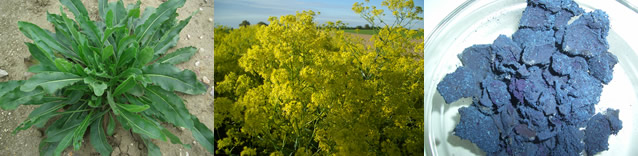
Woad (Isatis tinctoria), is a herb that looks like a cross between spinach and sugar-beet and from which a
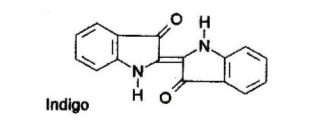
blue pigment is produced, that we now know as indigo (formerly called indigotin). However the indigo is not
produced directly from the plant, but is derived from two precursors, indican and isatan B, which are found mainly in the leaves.
These precursors are extracted from the woad and the indigo is produced outside of the plant, using a simple process.
The indigo produced from the woad plant has the same chemical formula and properties as that derived from the plants
Indigofera spp., Polygonum tinctorium, or manufactured synthetically by a chemical process.
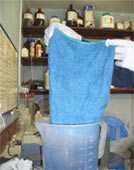
A range of blues from pale sky-blue to a rich cobalt-blue can be produced by dyeing with woad-derived indigo, on many natural and synthetic fabrics.
A highly interesting chapter about dyeing with woad is given in Jill Goodwin's
book "A Dyer's Manual", and Jenny Dean's book "Wild Colour" clearly illustrates the various colours
available from the leaves and seeds. For more information about these books, please see our Additional Resources page.
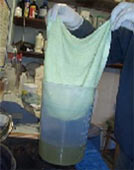
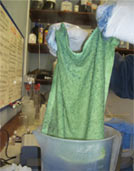
Woad has its own alchemy in the dyeing process and it is fascinating to see.
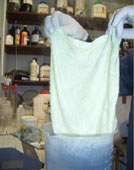
Indigo only permanently fixes to fibres when it is in a reduced state known as indigo white. The item for
dyeing is immersed in the mixture and, when lifted out, it turns from yellow to green and,
finally, to blue when it oxidises in the air!
The benefit of growing woad again as a colouring material is to offer an alternative to the harmful chemicals used in synthetic indigo dyeing whilst using a sustainable resource. Synthetic indigo is made industrially from three toxic chemicals: aniline, formaldehyde and hydrogen cyanide, which are derived mainly from non-renewable resources. These are reacted together to form an intermediate, phenylglycine, from which synthetic indigo is made.
However, the indigo we produce is extracted from the woad plant and no industrial processing is used in its manufacture. The Soil Association, in the context of their Organic Textiles Committee recommendations, has approved the chemicals used. There are no environmentally unfriendly waste products involved in producing natural indigo from woad.
|